Costa Rican Dance
Last Updated: Feb 21, 2012
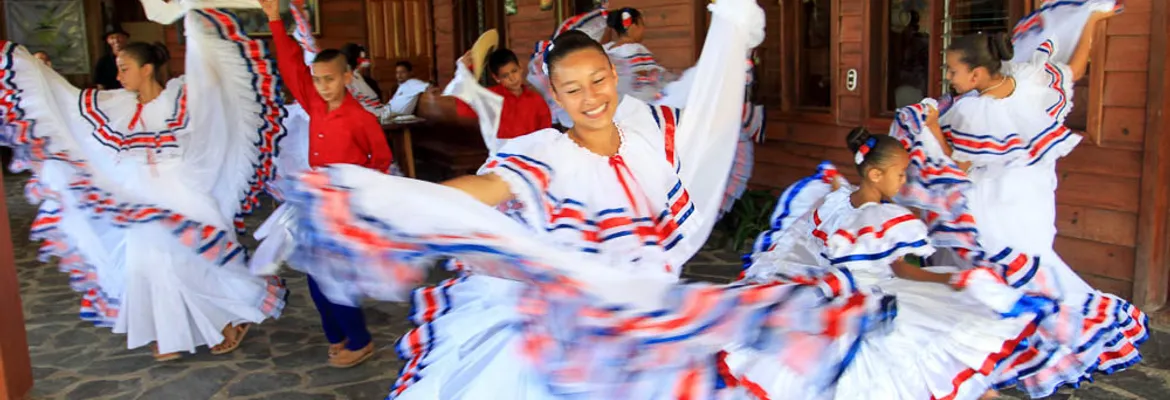
A place to dance can be found in every city and town, from San Jose’s modern discos to festive dance halls in rural areas. Costa Ricans are very fond of tropical melodies, especially merengue, salsa and cumbia; children learn the basic steps from an early age, and many Costa Ricans are accomplished dancers. For a more traditional taste, folkloric dances like the Punto Guanacasteco and La Cajeta depict colorful stories of a bygone era. They are often featured in holiday parades, where the dancers twirl about in vibrant costumes.
Merengue
Merengue is one of the most popular Latin dances in Costa Rica – it can be heard in almost every home, discotheque and radio station in the country. It has a two-step beat that features fast footwork and swaying hips. The man leads and usually holds the woman by her waist and right hand. Merengue is a tight dance, and couples move within a small circle; when steps are made in any direction, they only traverse the space of a few feet. It’s easy to find somewhere to dance merengue, but to give it a whirl at home, look for music from Grupo Mania, La Makina or Los Hermanos Rosario.
Salsa
Another popular local dance, salsa originated in Cuba and was influenced by mambo, Guaguanco and Afro-Caribbean beats. It blends quick steps with sensual movements in a three-step rhythm danced over each four-beat measure. As in most Latin dances, the man leads holding one or both of his partner’s hands. Experienced salsa dancers often employ complicated spins and intricate steps, which add panache to their dance. Like merengue, it is easy to find a club that plays salsa music; popular artists include Elvis Crespo, Celia Cruz and Salsa kids.
Cumbia
Originating in Colombia, cumbia is one of Costa Rica’s favorite tropical rythyms. Drums and other percussion instruments create the pervasive cumbia beat, which plays out in a 4/4 rhythm structure of long-short-short-long. Cumbia is typically danced to the Colombian music of the same name; however, Costa Ricans make the cumbia all their own, dancing a cumbia beat to the steps of the “swing criollo.” Swing criollo mixes elements of the Lindy hop and jive to create bouncing steps and small kicks that are danced in a circle of complex footwork and fancy spins. This dance style is very Costa Rican and a source of national pride. The Costa Rican song “Jugo de Pina” is one of the world’s most famous cumbia songs. Alberto Pacheco, Lucho Bermudez y Su Orquesta, Lisandro Meza and Edmundo Arias are all popular cumbia artists.
Folkloric Dancing
Costa Rican folkloric dancing is a joy to watch, as each dance tells a story in its own melodious and artistic way. The Punto Guanacasteco is the most easily recognized of traditional dances: as marimbas tap out the beat, women two-step toward partners who try to seduce them.
A tamer dance is La Cajeta, which represents Costa Rican traditions of creating milk caramel candy. Since the process could take days, families celebrated the culmination of candy making with a house party. This was the ideal time for young people to meet, and so La Cajeta – named after the caramel candy – represents the circumstances of this first meeting and the sweetness of young love.
Costa Rica’s indigenous cultures are also rich with folkloric dances such as the Borucan Diablitos dance. Every January, the Boruca celebrate the indigenous flight from – and in this version, triumph over – the Spanish conquistadors, who are represented by a bull that loses to formidable little demons. It is possible to view folkloric dancing year-round, but the best times are around the Annexation of Guanacaste (July 25), during oxcart parades, or at other traditional festivals.
Stay Connected
Get updates, special deals and our monthly newsletter!
